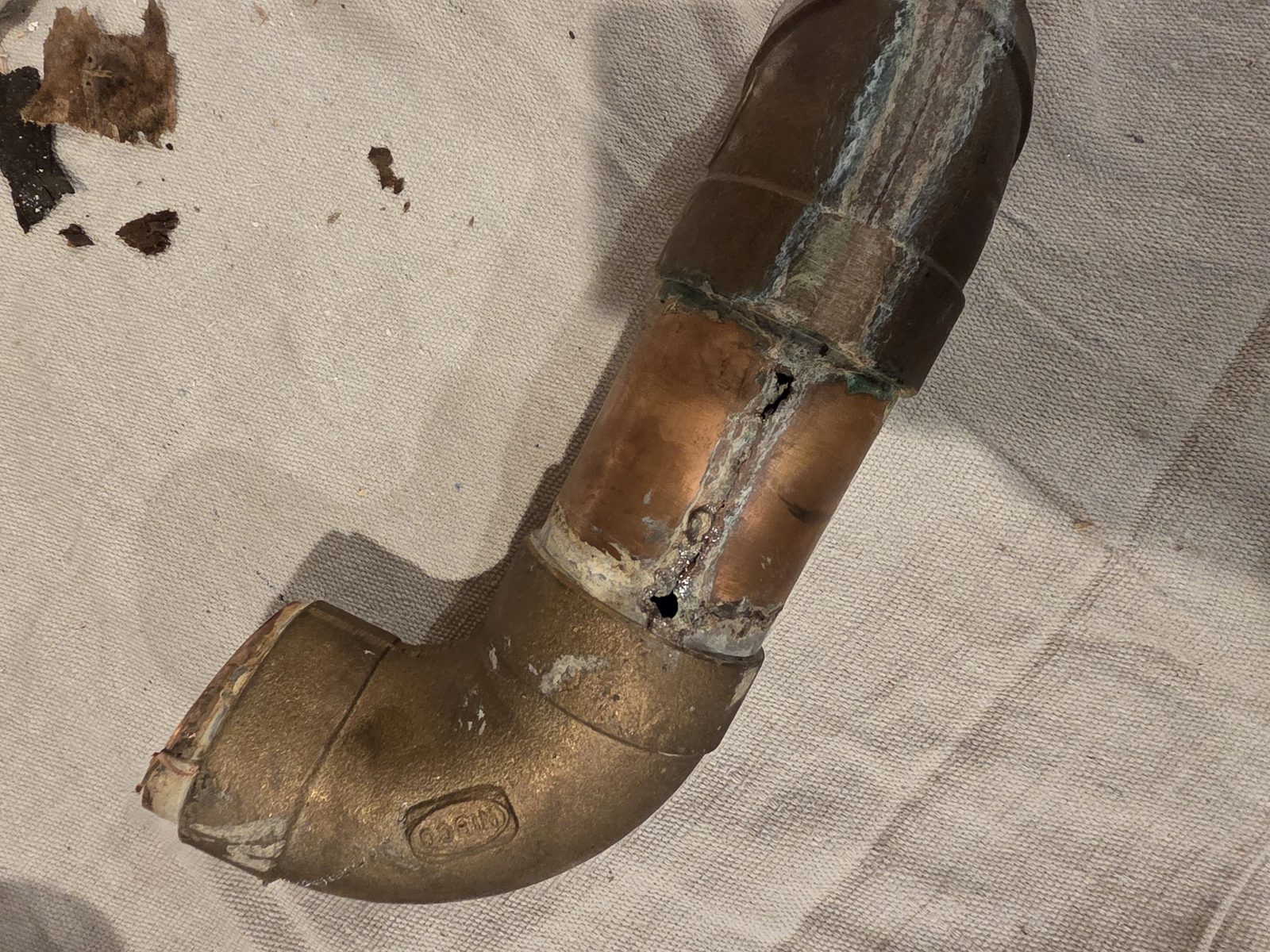
The elbow in the photo above came out of a Chicagoland basement earlier this month. It's a brass/copper DWV assembly — drain, waste, and vent piping — original to the house. Look closely: two clean pinholes worn straight through the wall of the copper, and heavy verdigris corrosion streaking down the outside from where the pipe has been weeping for years. The homeowner didn't know until water started showing up on the finished basement ceiling below.
Copper DWV was the premium drain material for decades. In homes built across Elk Grove Village, Schaumburg, Arlington Heights, Des Plaines, Lombard, Elmhurst, Bloomingdale, and neighboring suburbs from roughly 1955 to 1985, it's still what's carrying your waste to the sewer. And in a lot of those homes, it's now failing — quietly, from the inside out. Here's why, what makes it worse, and what to do about it before the ceiling gets stained.
What Copper DWV Is (and Why Chicagoland Has So Much of It)
DWV stands for Drain, Waste, and Vent — the entire network of pipes that carries wastewater from your fixtures to the sewer, plus the vent stack that keeps drains flowing and traps sealed. In older Chicagoland homes you'll typically find one of two DWV materials:
- Cast iron — heavy, black, hub-and-spigot or no-hub. Common in main stacks and horizontal branches.
- Copper DWV — thin-wall Type DWV copper (thinner than water-supply copper), often used for horizontal branch drains, vent runs, and sometimes entire stack replacements in mid-century builds.
Copper DWV was chosen because it was cleaner to install, quieter under fixtures, resistant to root intrusion, and — at the time — expected to outlast the house. It did outlast the first generation of homeowners. It's not outlasting the second.
Why Copper DWV Thins and Develops Pinholes with Age
Unlike a supply line under pressure, DWV copper carries wastewater that's aggressive in ways clean cold water never is. Corrosion happens from the inside surface outward, and it accelerates with time. The mechanisms we see in Chicagoland pipes we cut out:
1. Wall thickness was never generous to begin with
Type DWV copper is thinner than Type L or Type M supply copper because it doesn't need to hold pressure. That thin wall is fine for the first few decades — and it's exactly what runs out of room to lose material after 40+ years of interior corrosion.
2. Aggressive wastewater chemistry
What runs through a DWV pipe every day: soap residue with alkaline pH, hot detergent from dishwashers and washing machines, hair-and-oil emulsions from showers, food waste from disposals. Combine that with Lake Michigan hard water and dissolved oxygen, and you have a slow electrochemical attack on the copper wall — decade after decade.
3. Solder joints and dissimilar-metal galvanic action
Look at the photo hero above. The heavy corrosion at the top of the pipe — the streaky green verdigris — is right at a soldered joint. Old lead-tin solders and brass fittings sit in electrical contact with the copper, and in the presence of a moist waste environment they form a mini-battery that eats the copper preferentially. Joints are almost always where copper DWV fails first.
4. Standing water in traps and horizontal runs
Any low spot in the drain system — a P-trap, a slight belly in a horizontal run, an accessible cleanout — holds wastewater between uses. Standing water sitting against thin copper is the single most damaging condition to the pipe. Pipes on frequently used runs (kitchen, laundry) fail faster than seldom-used vent-only sections.
5. Chicagoland freeze/thaw and mechanical vibration
Vent stacks that terminate through the roof see temperature swings from -10°F to 90°F yearly. Vibration from garbage disposals, washing machines, and clogged fixtures adds mechanical stress at joints. Copper is soft; over decades it work-hardens and cracks preferentially at fittings.
Why Traditional Power Rodding Can Punch Through Weakened Copper
Here's the failure mode most Chicagoland homeowners never hear about until it happens: a clogged kitchen line gets power-rodded, the pipe was already thinning, and the cable spinner punches straight through the wall inside the ceiling or wall cavity. Suddenly the drain isn't the problem anymore — you have a drywall repair, a possible mold job, and an unscheduled copper drain replacement.
What actually happens during power rodding on aged copper:
- The cable spins at 300–600 RPM while being pushed through the pipe. That's a rotating shaft dragging along the inside wall.
- The cutting head is metal. In a fresh pipe with full wall thickness, the head skims the interior and cuts the blockage. In a wall that's already lost 60–70% of its thickness, the head grinds through instead of past it.
- Elbows and fittings take the worst of it. The cable naturally rides high on the outside of every bend. That's where the wall is thinnest to begin with and where the cable applies the most side-load.
- Punctures happen without warning. From the plumber's end, the rodding "cleared" — you feel resistance drop as the cable breaks through. The homeowner sees the leak days later when the drywall stains.
This is not a hypothetical. It's a monthly occurrence somewhere in our service area, and it's the reason we always camera-scope suspect copper DWV before running a cable through it.
How Store-Bought Chemical Drain Cleaners Accelerate the Corrosion
The other thing quietly destroying Chicagoland copper DWV is sitting on the drain-cleaner shelf at every hardware store. Those bottles labeled to "dissolve" clogs work by being extremely reactive — sulfuric acid, sodium hydroxide (lye), or bleach-based oxidizers. Great at breaking down hair and grease. Also great at attacking metal.
Why they're worse in copper DWV than in PVC
- They pool right at the corrosion hotspots. Chemical cleaner poured down a slow drain sits in the P-trap, the horizontal belly, and against every fitting — exactly the spots that are already thin.
- Heat multiplies the damage. These chemicals generate significant heat as they react with organics. Hot, aggressive chemistry pressed against thin copper accelerates pitting dramatically.
- Repeat use compounds. "Just once every few months" over 15–20 years is a very long time to soak thin copper in oxidizing chemistry.
- They don't actually clear the underlying problem. A grease and hair buildup returns; the pipe damage doesn't. Every dose is deposit made against future pipe failures.
What we recommend for maintenance instead
- Enzymatic drain maintainers — bio-based, safe for copper, cast iron, and PVC. Won't attack the pipe.
- Regular hot-water flushes for kitchen drains — a kettle of hot water down the drain every couple of weeks does more than any bottle.
- Mechanical clearing when you actually have a clog — the right tool at the right pressure, not a chemical that keeps working long after the clog is gone.
Warning Signs Your Copper DWV Is Failing
- Green (verdigris) staining on the outside of any DWV pipe — corrosion has already breached the wall somewhere upstream.
- Water stains on a ceiling below a bathroom, kitchen, or laundry — often mistaken for a supply leak; frequently it's the DWV.
- Musty smell in a wall or ceiling cavity with no obvious cause — a slow DWV pinhole is weeping into the framing.
- Recurring slow drain on a specific fixture — buildup accumulates faster where the pipe has interior pitting.
- Home built 1955–1985 and never repiped — you're firmly in the window where original copper DWV starts failing.
- Any history of chemical drain cleaner use — assume the interior is worse than it looks.
What We Do When We Find Failing Copper DWV
- Camera scope the accessible run to identify the extent of thinning and pinholes.
- Isolate the failing section — often we can replace a specific horizontal branch or fitting rather than the whole system.
- Replace with modern DWV-rated PVC or ABS — code-compliant, corrosion-proof, and rated for a century-plus service life.
- Preserve the vent stack routing where possible so we're not opening up more walls than necessary.
- Pull the municipal permit — Elk Grove Village, Schaumburg, Lombard, Naperville, Bloomingdale all require permits on drain replacement.
- Restore drywall/ceiling access points or coordinate with a trusted drywall trade if the scope requires it.
See green staining or a mystery leak? Book a camera inspection — we'll show you what's actually happening inside the pipe.
Copper DWV FAQ
How long does copper DWV last?
Design life was 50+ years under normal conditions. In practice, in Chicagoland homes with hard water and any history of chemical drain cleaner use, we see failures starting at year 40 and getting common by year 55.
If one section of my copper DWV has failed, does it all need to be replaced?
Not necessarily. We scope the accessible run and identify which sections are still sound. Sometimes a targeted replacement of one horizontal branch and its fittings buys you another decade on the rest of the system. Other times — especially with kitchen drains that have seen chemical cleaners — the whole run is compromised and full replacement is the honest recommendation.
Is PVC a step down from copper for drains?
No — for DWV specifically, modern PVC (or ABS) is the better material. It doesn't corrode, doesn't develop pinholes, isn't attacked by the wastewater chemistry that eats copper, and carries a longer real-world lifespan. Copper's advantages were quieter operation under fixtures and cleaner installation aesthetics; both are non-factors once the pipe is behind drywall.
Can you rod my drain safely if the copper is old?
We can — but not without scoping it first. If the pipe wall is intact enough to survive a cable, we'll use a low-RPM head sized correctly and clear it. If the wall is too thin, we tell you upfront and recommend a different approach, because the last thing you want is a service that leaves you with a puncture.
Do you offer 24/7 emergency service for drain leaks?
Yes. If you have an active drain leak from a failed copper DWV pipe, call (847) 306-9736. We prioritize water-damage-in-progress calls across Elk Grove Village, Schaumburg, Arlington Heights, Lombard, Bloomingdale, and neighboring suburbs.
Ready to talk water heaters?
Get a firm quote from a Level 3 Certified installer.
We'll come out, size the right unit for your family, and give you an all-in price before any wrench turns. No pressure, no surprise adders.