
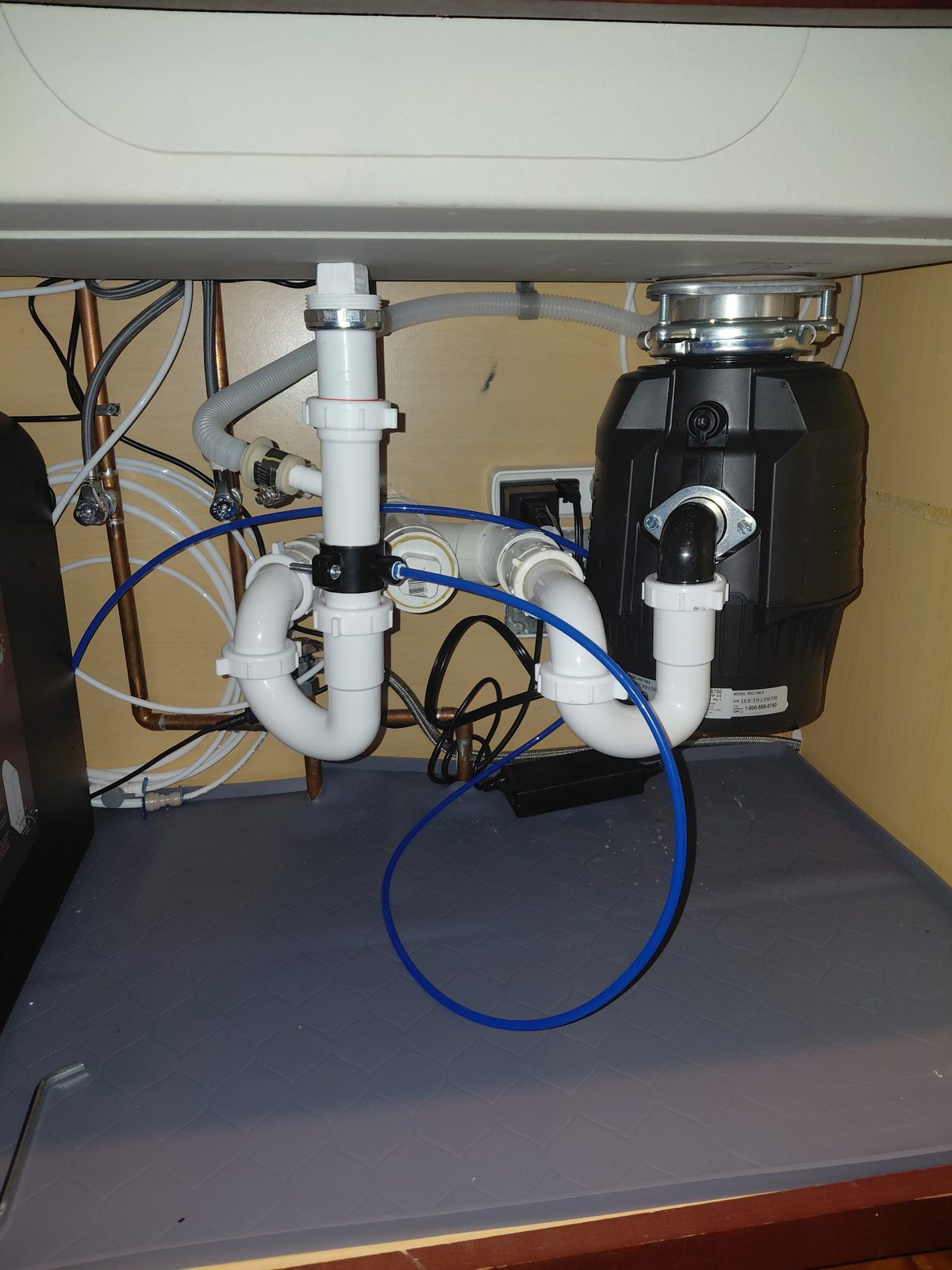
Most Chicagoland kitchens have a garbage disposal nobody thinks about until the morning it hums instead of grinds. Then it becomes the most important fixture in the house for about 20 minutes. We've replaced hundreds of them across Elk Grove Village, Schaumburg, Arlington Heights, Lombard, Bloomingdale, Hanover Park, and the surrounding suburbs — and we've learned that the difference between a disposal that lasts 14 years and one that dies at 4 comes down to three things: the horsepower you installed, what you fed it, and the installer who put it in.
This is the honest guide. No marketing, no brand loyalty — just what actually matters when you're picking, using, and eventually replacing a garbage disposal in a Chicagoland home.
Garbage Disposal Horsepower: What the Numbers Actually Mean
Horsepower (HP) is the single biggest spec on any disposal, and it's where most homeowners (and some plumbers) under-spec the install. Here's the honest breakdown of what each HP class is good for in a Chicagoland kitchen:
1/3 HP — The builder-grade minimum
This is the disposal that came with your new-construction home in Schaumburg or Naperville and the one in the clearance bin at the box store. It'll grind soft food scraps — banana peels, cereal, soft vegetables — and that's about it. Try an apple core and it hesitates. Try corn husks or celery and it jams. Lifespan on 1/3 HP under normal family use is often 3–5 years. We install these only when the budget absolutely requires it and we tell the homeowner it won't last.
1/2 HP — The right starting point for most homes
This is where we recommend most Chicagoland families start. A quality 1/2 HP has enough torque to handle real kitchen scraps (apple cores, meat trimmings, moderate vegetables) and generally comes with better internals — stainless steel grind chamber, better sound insulation, overload protection. Lifespan under normal use lands in the 7–11 year range.
3/4 HP — The sweet spot for busy kitchens
If your household cooks a lot, has 4+ people, or you've ever jammed a disposal before, go 3/4 HP. More torque means it clears tougher scraps without binding, grinds finer so the drain line clogs less, and runs quieter under load. The upgrade from 1/2 HP to 3/4 HP is usually a small price delta at install for a noticeably better daily experience. Lifespan is similar — 9–14 years common.
1 HP — Overkill for most, perfect for some
For large households, home chefs, homes with regular entertaining, or anyone who's gone through multiple cheaper disposals, a 1 HP unit is a one-time investment that just works. Heavy-duty internals, best sound insulation, highest grind-chamber capacity, longest expected service life (11–16 years isn't unusual on a well-maintained 1 HP).
Features Worth Paying For (and Features That Are Marketing)
Actually matter
- Stainless-steel grind chamber. Galvanized or alloy chambers rust from the inside out. Stainless lasts.
- Sound insulation. The jump from a cheap disposal to a well-insulated one is dramatic. Your spouse and your dog will both thank you.
- Overload protection with manual reset. When a disposal binds, you want a reset button on the bottom — not a toasted motor.
- Multi-stage grind. More grinding stages mean finer output, which means your drain line clogs less and smells less.
- A real power cord included (or clean hard-wire capability). Some bargain units ship without cords on purpose — be ready for the surprise.
Mostly marketing
- "Anti-jam" rebranded features. All disposals jam if you feed them wrong. A good overload reset matters more than the sticker on the box.
- Bluetooth / Wi-Fi disposals. We install plenty of modern kitchens; we don't yet have a customer who misses this feature.
- Odor-shield pads built into the splash guard. Removable splash guards cleaned regularly do the same job for free.
Continuous Feed vs. Batch Feed — Which Should You Pick?
Two main operating styles, and they're genuinely different:
- Continuous feed — the common type. A wall switch runs it; you drop scraps in while running water. 95% of Chicagoland installs we do are continuous feed.
- Batch feed — you load the chamber, insert a magnetic stopper, and twist to activate. Can't run with your hand in it, which is a real safety advantage, especially in homes with small kids. Slower to use, costs more upfront, but genuinely safer. Worth considering if you have young children in the kitchen regularly.
What You Should NEVER Put in a Garbage Disposal
This is the single most-asked question we get, and the honest answer is: a lot of things homeowners currently drop in without thinking. Every one of these shortens disposal life, clogs drains, and in a surprising number of cases is what killed the disposal we're replacing:
Hard materials — damages the grinding components
- Bones of any kind (chicken, pork, beef, fish — all of them)
- Fruit pits — peach, avocado, cherry, mango
- Nuts and shells — walnuts, pecans, etc.
- Seafood shells — shrimp, crab, lobster, oyster
- Non-food items — twist ties, bottle caps, utensils (yes, we find these a lot)
Starchy and expanding foods — clogs the drain line downstream
- Pasta and rice — they absorb water and swell inside your trap. One of the top causes of kitchen drain backups.
- Bread dough — same problem, worse.
- Potato peels — the starch turns to paste and lines your drain pipe.
- Oatmeal in volume — gels in the trap.
Fibrous materials — wraps around the grinder
- Celery, asparagus, corn husks — long fibers wrap the shredder ring and bind the motor.
- Onion skins — thin, slick, and skips past the grinder to clog the drain.
- Banana peels — small amounts fine, large amounts bad.
- Artichoke leaves, pea pods — same category.
Fats, oils, and grease (FOG) — the #1 drain killer in Chicagoland
- Bacon grease, cooking oil, pan drippings — liquid in the pan, solid in your drain by the time it cools in your basement.
- Butter, lard, shortening — same deal.
- Greasy sauces and gravy — accumulate over time.
- Dairy fats — cream, melted cheese, ice cream.
FOG is the single biggest reason we camera-scope grease-coated horizontal drain lines in older Chicagoland homes. Let grease solidify in a container, throw the container in the trash. Your drain line (and your plumber) will thank you.
Chemical and cleaning products — damages the pump seals and your pipes
- Chemical drain cleaners — we covered this at length in our copper DWV article. They attack metal in your disposal and in your drain pipes alike.
- Bleach in volume — degrades rubber splash guard and motor seals over time.
- Paint and solvents — never. Dispose properly.
How Long Should a Garbage Disposal Last?
Real-world lifespan depends heavily on HP class and what the household feeds it. Averages we see in Chicagoland kitchens we service:
- 1/3 HP builder-grade: 3–5 years
- 1/2 HP quality unit: 7–11 years
- 3/4 HP commercial-grade: 9–14 years
- 1 HP heavy-duty: 11–16 years
Any disposal in a kitchen that regularly ignores the "do not put in" list above lands at the low end of its class. A conscientiously used disposal lands at the high end.
Warning Signs You Need a New Garbage Disposal
- It hums but doesn't turn. The grind wheel is seized. Sometimes the reset button + an Allen key spin fixes it; sometimes the motor's done.
- It leaks from the bottom of the unit. The motor seal has failed. These are not practical to repair — the labor to tear a disposal down is more than a new install, and the seal fails again anyway. Replace.
- It leaks from the top collar. Sometimes just a worn gasket, but on older units the mounting flange is corroded. If we tighten and it leaks again, replacement.
- Food sits in the chamber after running. The grind components are too worn to pulverize anything — it's shredding, not grinding. Drain line clogs will follow if you keep running it.
- It runs louder than it used to. Bearings are going. Noticeable noise increase is often the last 6 months of a dying disposal.
- It's over 9 years old and getting cranky. Preemptive replacement is cheaper than a mid-dinner-party failure.
- You just moved into an older Chicagoland home. Check the disposal's age — most previous owners don't replace them until they fail, so you may have inherited a time bomb.
Our Garbage Disposal Install Process
- HP sizing based on your household. We'll ask about family size, cooking style, and what's gone wrong before. No upselling just to upsell.
- Correct electrical. Hardwire or outlet with GFCI protection as code requires — a surprising number of older installs we see are miswired.
- Code-compliant dishwasher drain routing — air gap on the counter where required, into the sink tailpiece above the P-trap. Never tied into the disposal. If we find an illegal tie-in on your existing setup, we correct it as part of the install.
- Proper drain pitch and P-trap configuration on the disposal discharge.
- Mounting ring correctly sealed with plumber's putty, not silicone (silicone doesn't seat properly and leaks later).
- Full load test. We run water, run the disposal, run the dishwasher, and verify no leaks and clean drainage before we leave.
Garbage disposal humming, leaking, or just living on borrowed time? Book a service call — we'll diagnose it and quote a replacement firm before any work starts.
Garbage Disposal FAQ
Can I replace a garbage disposal myself?
Legally in Illinois, replacing like-for-like doesn't always require a licensed plumber — but new installs where there wasn't one before, or any changes to the drain configuration, do. Practically, the places DIY installs go wrong are the dishwasher inlet, the drain pitch, the mounting-ring seal, and the electrical. If any one of those is wrong, you don't know until the first leak.
Why does my garbage disposal smell?
Food residue on the underside of the splash guard, in the grind chamber, and in the top of the unit. Pop the splash guard out (most are removable) and clean it. Then grind ice cubes with a cup of coarse salt — scours the chamber. Finish with a lemon or orange peel ground up for freshness. If the smell persists, the drain line below the disposal needs attention.
Should I run hot water or cold water with my disposal?
Cold. Cold water keeps fats and oils in solid form so they get ground up and flushed through, instead of melted into a film on your drain pipe. Only common piece of disposal advice everyone gets wrong.
Is a garbage disposal bad for my septic system?
If you're on a septic system (rare in our core suburban service area but common in outlying areas), a disposal increases solids load on your septic. It's not disqualifying, but it means more frequent tank pumping. If you have the choice, scrape plates into the trash first.
Do you offer same-day garbage disposal replacement?
Yes — in most of our core service area, including Elk Grove Village, Schaumburg, Arlington Heights, Lombard, Bloomingdale, and Hanover Park. If your disposal has failed and you want it swapped today, call (847) 306-9736 and we'll see what we can get on the schedule.
Ready to talk water heaters?
Get a firm quote from a Level 3 Certified installer.
We'll come out, size the right unit for your family, and give you an all-in price before any wrench turns. No pressure, no surprise adders.