If you've called two Chicagoland plumbers about a slow drain, you've probably been quoted two different services — rodding from one, hydro jetting from the other — with a real price gap between them. What's the actual difference? When is each one the right call? And when does an aggressive tool actually damage the pipe you're trying to save?
After 11+ years cleaning drains and sewers across the Chicagoland suburbs, here's the straight answer we give homeowners who ask us in the driveway before signing the work order.
The Fundamental Difference
Sewer rodding (mechanical cabling)
A rotating steel cable with a cutting head is pushed down the line. The head — depending on what we mount — either augers through a clog, cuts through tree roots, or scrapes buildup off the pipe wall. Mechanical force, physical contact, punches a hole through the problem.
Hydro jetting (high-pressure water)
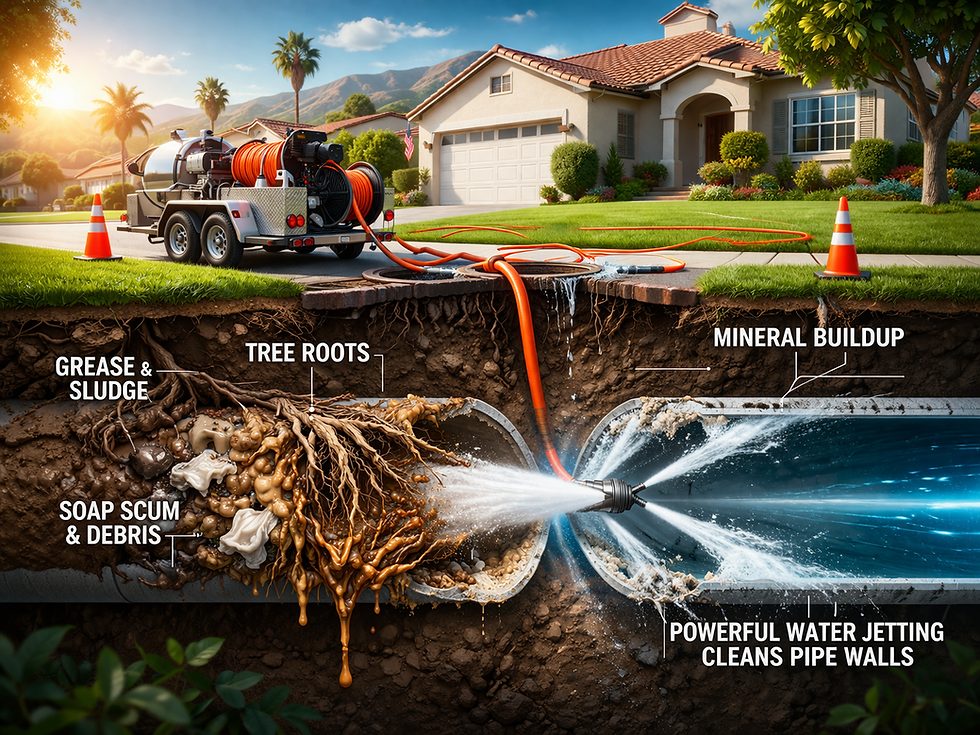
A high-pressure hose (2,000–4,000 PSI) with a specialized nozzle propels itself down the pipe. Rear-facing jets pull the hose forward and blast water backward — scouring the entire circumference of the pipe wall clean. Chemical/mechanical force, hydraulic pressure, cleans the whole pipe.
One punches a hole. The other cleans the whole pipe. That's the fundamental difference.
When Rodding Is the Right Call
- Active backup, need it cleared now. Rodding is faster to set up and gets flow restored quickly.
- Root intrusion at a specific joint. A cutting head chops through the root ball and re-opens the pipe.
- Hard blockages (toys, roots, mineral chunks) — mechanical cutting is more effective on solids.
- Cast iron in questionable condition. Rodding stresses the pipe less than 3,500 PSI water pressure.
- Budget conscious. Rodding is the more economical of the two methods when both are appropriate.
When Hydro Jetting Is the Right Call
- Grease buildup in kitchen and laundry lines. Water pressure emulsifies and flushes grease that a rod just pushes through.
- Sludge and buildup throughout a run. Rodding punches a hole; jetting cleans the whole pipe wall.
- Recurring clogs. If you've rodded the same line twice in a year, jetting removes the root cause (buildup) instead of just the symptom.
- Restaurants and commercial lines. Almost always the right tool.
- Pre-camera-inspection prep. We often jet a line before scoping so we get a clean picture of the pipe condition, not the pipe contents.
- Pre-CIPP-lining. Jetting is required before any pipe lining or trenchless work — the pipe wall must be clean for the liner to bond.
When Neither Is the Right Call
Sometimes homeowners want us to keep rodding a line that fundamentally needs replacement. We're honest about it:
- Collapsed sections. Neither tool restores a collapsed pipe. Cabling through a collapse can push debris out into the surrounding soil, making excavation harder.
- Severe channeling in cast iron. Aggressive jetting on a paper-thin cast iron line can blow through the wall. Camera inspection first, then decide.
- Bellied sections. You can rod and jet all day; the standing water and sediment will re-accumulate in weeks. Fix the belly, don't fight it.
- Orangeburg pipe. Do not put a jet nozzle in Orangeburg pipe. The material is too soft; you'll deform it and cause collapse.
When we scope your line and see one of these, we tell you. We'd rather quote you a spot repair or replacement than sell you three rodding services in a year that were never going to solve the problem.
The Wrong Tool Can Damage Your Pipe
This is where plumber experience genuinely matters. Rodding with too aggressive a cutter head on old cast iron can gouge the pipe wall. Hydro jetting at 4,000 PSI on structurally compromised pipe can breach it. Both tools are safe in trained hands and dangerous without judgment about what's inside the pipe.
Which is why we camera inspect first whenever there's any question about pipe condition — before we pick up any tool.
The MDM Drain-Cleaning Process
- Diagnose first. Where's the clog? Which fixtures are affected? Any history of recurring backups?
- Camera inspection when warranted. Especially for repeat calls or pre-1980 homes with cast iron.
- Choose the right tool. Rod for solids, jet for buildup. Never the reverse.
- Test flow. After cleaning, we run water and confirm the line drains fully.
- Recommend follow-up. If we jetted a line with heavy root intrusion, we tell you: it'll be back in 18–24 months unless the pipe is repaired.
Why Chicagoland Homeowners Call MDM for Drain Work
- Both tools in every truck. Rod and jet — we choose the right one, not the one we happen to carry.
- In-house camera. We can scope before, during, and after.
- 11+ years clearing drains across Elk Grove Village, Schaumburg, Arlington Heights, Lombard, Naperville, and neighboring suburbs.
- Honest quotes. If your line needs replacement, not another rodding, we say so.
- Same-day service in most of our core area. 24/7 emergency for active backups.
Slow drain or recurring backup? Book a diagnostic — we'll pick the right tool, not the most expensive one.
Drain Cleaning FAQ
How often should I get my sewer line cleaned?
If you have no history of backups and no known root intrusion: never, until something changes. If you've had roots or recurring buildup: annually or every two years, matched to your specific history. Blanket "clean it every year" recommendations are usually upsells.
Is hydro jetting safe for older pipes?
Depends on the pipe. Structurally sound cast iron: yes, at appropriate pressure. Compromised cast iron, clay tile with joint separations, or Orangeburg: no — camera inspect first, then decide the safe method.
Will chemical drain cleaner work instead?
For a hair clog in a sink trap, sometimes. For anything in the main line: no, and it's actively harmful. Chemical cleaners sit in the pipe, corrode joints, and don't dissolve roots or grease anyway. Don't waste your money.
Do you offer 24/7 emergency drain service?
Yes — for active backups causing water damage, we roll trucks day or night. Call (847) 306-9736.
Ready to talk water heaters?
Get a firm quote from a Level 3 Certified installer.
We'll come out, size the right unit for your family, and give you an all-in price before any wrench turns. No pressure, no surprise adders.