
Congratulations — you're a homeowner. Somewhere between closing and move-in, nobody hands you a manual for the plumbing. You inherit whatever the last owner installed, maintained, or ignored. And the first time a pipe bursts or the water heater lets go, you're expected to know exactly what to do.
We help new homeowners across Elk Grove Village, Schaumburg, Arlington Heights, Lombard, Bloomingdale, Naperville, Wheaton, and the surrounding suburbs every week. These are the things we wish every one of them knew on day one — starting with the three that matter most.
1. Find Your Main Water Shut-Off — Today
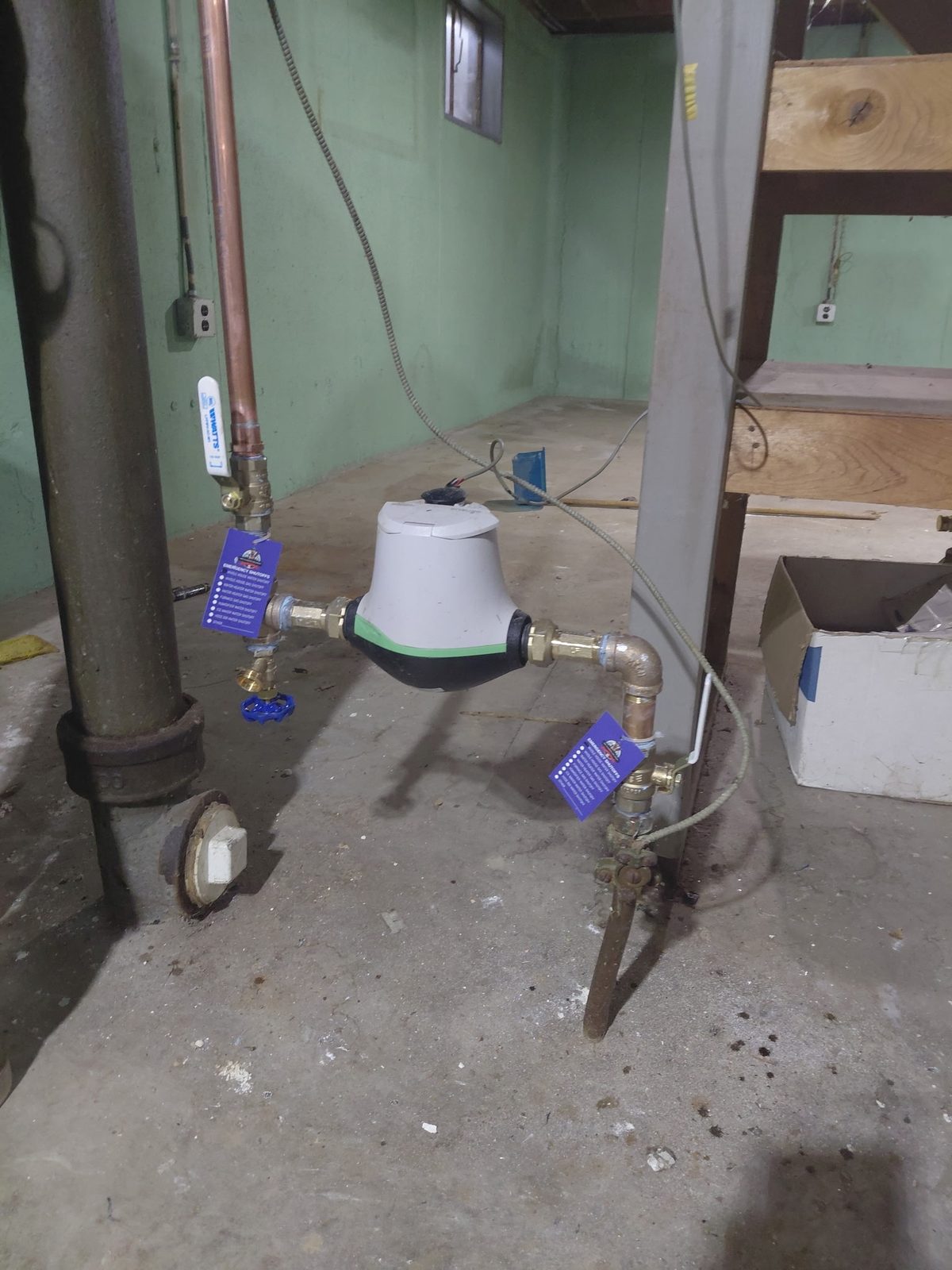
If you only do one thing from this article, do this. When a pipe bursts or a supply line fails, water can flow at several gallons per minute. The difference between a wet floor and a finished basement full of water is how fast you can turn off the main.
Where to look in a Chicagoland home
- Basement homes: almost always on the wall where the water service enters the house — usually the front foundation wall facing the street — right next to the water meter.
- Slab and crawlspace homes: check the utility room near the water heater, a garage wall, or a closet on the front side of the house.
- Look for the meter. In most suburban homes the main shut-off sits on the pipe right before the meter (street side), and there's often a second valve right after it (house side).
Test it — gently
Older homes often have a multi-turn gate valve (round wheel handle) that hasn't moved in decades. Turn it slowly clockwise to close. If it's stiff, don't force it with a wrench — old gate valves can snap their stem or break internally and leave you with no shut-off at all. Newer homes usually have a quarter-turn ball valve with a lever handle: lever parallel to the pipe is open, perpendicular is closed.
If your main valve won't close, only partially closes, or leaks at the stem when you turn it, have it replaced with a full-port ball valve. It's a small job that makes every future repair — and every future emergency — dramatically easier.
Know about the B-box (curb stop)
Out near the street, usually in the parkway, there's a buried valve called the buffalo box or B-box. That's the village's shut-off for your service line. It's operated by the municipality or a licensed plumber with the proper key — not the homeowner. If your inside main fails, that's the call your plumber will coordinate with the village.
Know your fixture shut-offs too
Every toilet, sink, and dishwasher should have its own small shut-off (angle stop) behind or under it. If a toilet is overflowing, you don't need to shut down the whole house — just turn the angle stop behind the toilet clockwise. If those valves are crusty, seized, or missing, put them on your list to replace.
2. Get Familiar With Your Water Heater
Your water heater is the appliance most likely to fail without warning in your first few years of ownership — and most buyers have no idea how old the one they just inherited is. Spend ten minutes getting to know it.
Find out how old it is
The manufacture date is encoded in the serial number on the rating label. Most brands, including Bradford White, encode the year and month in the first letters or digits — a quick search of the brand's serial-number format will tell you. A quality tank water heater in our area typically lasts 10–12 years. If yours is already near that range, start planning a replacement on your schedule rather than waiting for a cold shower or a leak.
Know your shut-offs and settings
- Cold water inlet valve — on the cold supply pipe at the top of the heater. Closing it stops water feeding the tank if it starts leaking.
- Gas shut-off — a yellow-handled or lever valve on the gas line feeding the heater. Handle perpendicular to the pipe is off.
- Electric models — the breaker in your panel labeled for the water heater.
- Temperature setting — around 120°F is the recommended starting point for most homes to balance comfort, efficiency, and scald protection.
Look for warning signs
- Rust or water at the base of the tank.
- Rumbling or popping noises — sediment buildup on the bottom of the tank.
- Rust-colored hot water or a metallic smell.
- Water dripping from the T&P (temperature and pressure relief) valve discharge pipe. That valve is a critical safety device — if it's discharging, have it checked.
- Scorch marks or soot near the burner access on a gas unit, or a flame that isn't mostly blue.
Make maintenance a habit
Chicagoland's hard water deposits sediment in tank heaters and scale in tankless units. Flushing a tank heater periodically and descaling a tankless unit like a Navien annually keeps efficiency up and extends its life. If you have a tankless unit, find out when it was last serviced.
3. Start a Relationship With a Local Plumbing Company — Before You Need One
The worst time to find a plumber is at 11 p.m. with water coming through the ceiling. That's when people end up calling whoever shows up first in a search — and paying for that panic.
Building a relationship with a local, licensed plumbing company early pays off in ways most new homeowners don't expect:
- They know your house. After one visit, your plumber knows where your main is, what your water heater is, and whether your sewer line is clay, cast iron, or PVC. The next call goes faster.
- You get an honest baseline. A plumbing walkthrough or a sewer video inspection early on tells you what you actually bought — and what can wait versus what can't.
- Priority when it matters. Established customers are the ones a local shop works hardest to fit in during storms, freezes, and holidays.
- Real accountability. A company in your community, with its trucks on your streets and its name on its work, stands behind what it installs.
Save your plumber's number in your phone and on the side of your water heater or electrical panel. When something goes wrong, you — or a house-sitter, or a family member — will know exactly who to call.
More New-Homeowner Plumbing Checks
Test your sump pump before spring storms
If your home has a sump pit, slowly pour a bucket of water into it and make sure the pump kicks on, empties the pit, and shuts off. Note the pump's age — sump pumps typically last 6–8 years. If there's no backup pump, that's worth adding. We install Liberty primary pumps with Pro Series battery backups, or a Water Commander water-powered backup on homes with municipal water.
Know where your floor drains and cleanouts are
Find your basement floor drain and your main sewer cleanout (usually a capped fitting on the main drain near where the sewer exits the house). Keep both accessible — don't box them in with storage or finish walls over them.
Get your outdoor faucets ready for winter
Before the first hard freeze, disconnect garden hoses from every outdoor faucet. A hose left attached traps water in a frost-free sillcock and can split it inside the wall — the leak often isn't noticed until spring.
Check toilets for silent leaks
Put a few drops of food coloring in the toilet tank and wait 15 minutes without flushing. Color in the bowl means the flapper is leaking — wasting water around the clock.
Keep chemicals out of your drains
Skip the chemical drain cleaners and keep wipes and grease out of the toilet and kitchen sink. Most of the clogs we clear in newly purchased homes are habits, not pipe failures.
New to the neighborhood? Book a service call with MDM Plumbing & Sewer — we'll get to know your home's plumbing so you're ready before anything goes wrong.
New Homeowner FAQ
Should I get a sewer inspection even after closing?
Yes, if it wasn't done before purchase. A sewer video inspection shows the material, condition, and any root intrusion or damage in your line, so you can plan maintenance instead of discovering a problem through a basement backup.
How do I know if my main shut-off valve needs replacing?
If it won't turn, only closes partway, leaks from the stem, or the water never fully stops when it's closed, it should be replaced. A full-port ball valve is the upgrade we recommend.
What should I do first if a pipe bursts?
Shut off the main water valve, turn off the water heater's gas or power if the leak is near it, move valuables away from the water, and call a plumber. If you're in our service area, call (847) 306-9736.
Do you service my area?
We serve the northwest and west Chicago suburbs including Elk Grove Village, Schaumburg, Arlington Heights, Lombard, Bloomingdale, Hanover Park, Naperville, Wheaton, Elmhurst, and many more. Check our service areas page for the full list.
Ready to talk water heaters?
Get a firm quote from a Level 3 Certified installer.
We'll come out, size the right unit for your family, and give you an all-in price before any wrench turns. No pressure, no surprise adders.