
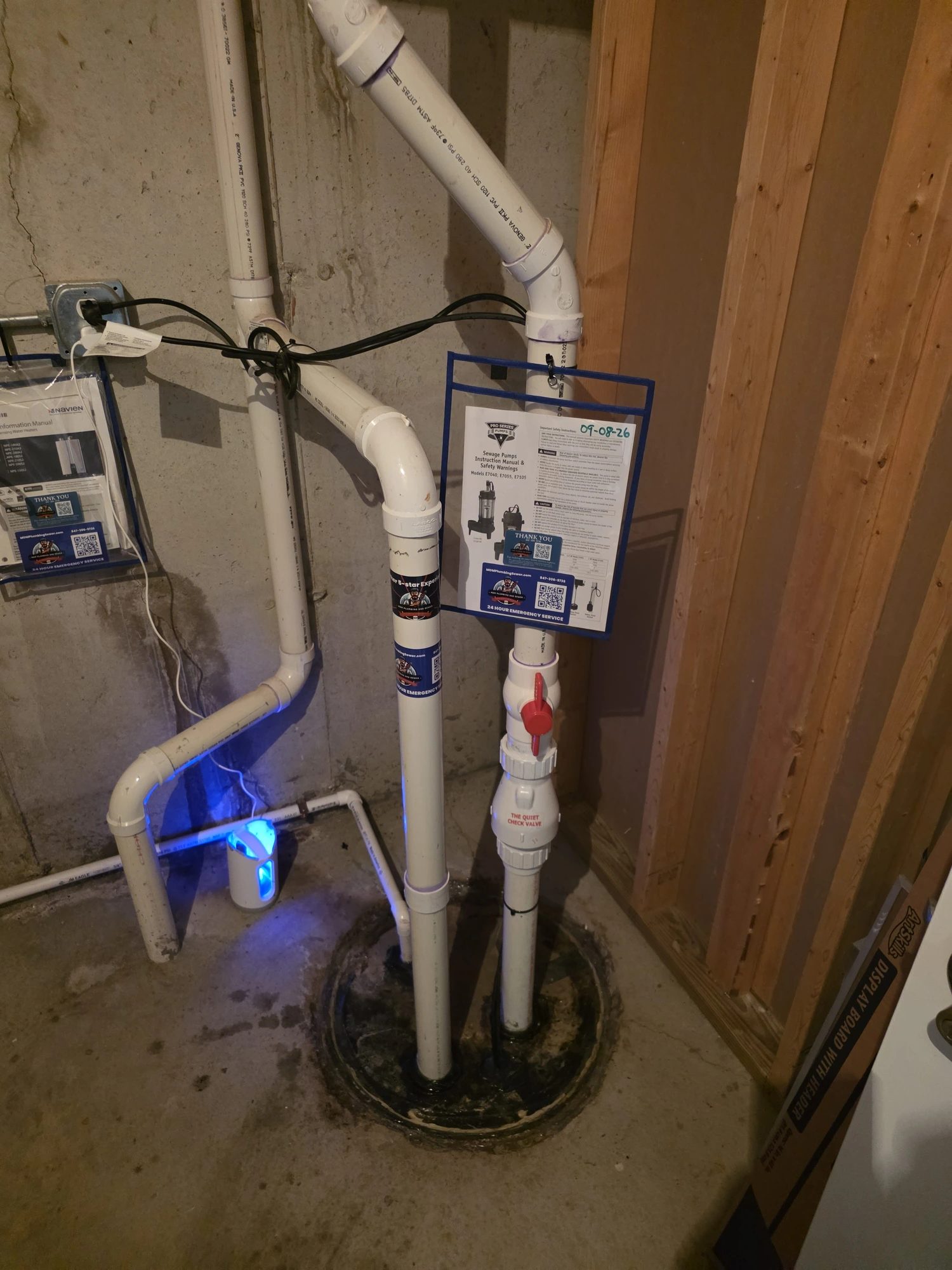
Almost every finished basement in Elk Grove Village, Schaumburg, Bloomingdale, Lombard, and the surrounding suburbs has one: a sewage ejector pump. If your basement bathroom is below the main sewer line — which is true for most Chicagoland basements — gravity can't move waste to the street. An ejector pump has to.
For 11+ years we've installed and replaced ejector pumps across the northwest and west Chicago suburbs. What we've learned is that this specific pump has more "looks fine, isn't fine" installations than almost any other fixture in a home. The pump might be running. The plumbing might be permitted. And the basement can still smell like a sewer because two specific details got rushed. Here's the honest breakdown.
Ejector Pump vs. Sump Pump: They Are Not the Same
This is the #1 confusion we clear up in customers' driveways. Two pumps in two pits in the same basement, doing entirely different jobs:
- Sump pump — moves clean groundwater from the perimeter drain tile to the outside. The pit is open-top; the water is (mostly) clean; discharge dumps into your yard.
- Sewage ejector pump — moves black water (toilet + shower + sink + laundry waste) up to the main sewer line. The basin must be sealed and vented because what's inside is raw sewage. Discharge ties into the sanitary sewer, never the yard.
If someone has ever told you they're "the same pump" — they aren't, and you don't want the person confusing them near your basement bathroom.
Why We Install Pro Series Sewage Ejector Pumps
For sewage ejectors specifically, we install Pro Series pumps almost exclusively. After trying most of the major brands over the years, Pro Series is the one that keeps running past year 7 without a callback. What actually matters in a sewage pump:
- Cast-iron pump body. Plastic-body sewage pumps corrode in the environment they live in. Cast iron doesn't.
- 2" solids handling. Sewage ejectors need to pass what actually goes down a toilet — cheap pumps clog on things they shouldn't.
- Sealed, non-clogging impeller design. Impeller geometry that shreds and passes solids without binding up.
- Vertical float mechanism. Tethered floats in sewage basins fail — they get caught on baffles, grease, and each other. We spec vertical only.
- Available in 1/2 HP and higher — sized to head height and run length. A 1/2 HP with 12+ feet of lift will struggle; we upsize on longer runs.
Detail #1: A Premium Ball & Quiet Check-Valve Combo — Every Time
Every one of our sewage ejector installs gets a premium ball valve + quiet check-valve combination on the discharge. Not the cheap swing check that comes standard on many rough-ins. Here's why the combo isn't optional:
The full-port ball valve
A ball valve on the discharge — installed as part of the combo — is there to isolate the head and run of the discharge line when the pump needs to come out. Shut the ball valve and everything sitting above it (the vertical head + the horizontal run to the sanitary stack) stays put. Without it, the moment you break the union to pull the pump, every gallon of sewage sitting in the discharge line dumps back through the fitting, into the basin, and onto whoever is standing over it. With it, one quarter-turn stops the column and the pump comes out clean.
The quiet check valve — this is the game changer
A standard swing check-valve slams shut every time the pump cycles off. In a basement bedroom, that "THUD" is loud enough to wake anyone sleeping nearby. Homeowners live with it because they think that's just how ejector pumps sound.
A quiet (spring-loaded) check valve closes gradually as flow stops. No slam. No water hammer. No 3 AM thud when the upstairs toilet flushes. We install a premium quiet check on every ejector we set — it's a small upcharge at install and it's the single most-praised thing we do on this pump.
Detail #2: The Basin Lid Must Be Sealed to Manufacturer Spec
This is where honestly done ejector installs and shortcut installs diverge — and where the sewer gas conversation begins.
What's actually inside the basin
Raw sewage. It contains methane, hydrogen sulfide, and other gases produced by anaerobic decomposition. In tiny concentrations, hydrogen sulfide smells like rotten eggs. In larger concentrations it deadens your sense of smell and becomes a serious health hazard. The basin is designed to be a sealed, vented pressure system — meaning gases can only escape one place: up the vent stack, through the roof, to the outside.
How basin lids get installed wrong
- Gasket omitted or wrong size. The manufacturer ships a specific gasket for a reason. Skipping it or reusing a torn one leaves an open leak path.
- Bolts hand-tightened instead of torqued in a star pattern. Uneven pressure = uneven seal = gas escape.
- Cable and pipe pass-throughs not sealed. Every pipe entering and every wire exiting has to be sealed with the correct grommet or approved sealant. Most "mystery smell" callbacks trace back to a rushed pass-through.
- Vent line not properly connected or vented into the basement instead of tied into the sanitary stack. This is a code violation and a health issue.
How we seal a basin lid
- New OEM gasket every install — no reused gaskets, no substitutes.
- Bolts torqued in a star pattern to manufacturer spec.
- Every cable pass-through sealed with the correct grommet.
- Every pipe pass-through sealed with an approved compound rated for sewage service.
- Vent line connected to the sanitary stack per Illinois plumbing code, terminating above roof line to the outdoors — never into the basement.
Sewer Gas Smell in Your Basement: Where It Usually Comes From
If you smell sewage in a Chicagoland basement, the ejector pit is one of five likely sources. We diagnose all five before recommending work:
- Failed ejector basin seal — most common if there's an ejector pit. Gasket, cable pass-through, or pipe pass-through leaking.
- Dried-out floor drain trap — the trap is designed to hold water and block gas. If a floor drain hasn't been used in months, the water evaporates and gas comes up. Pour a gallon of water down every basement floor drain quarterly.
- Ejector vent piped incorrectly — venting into the basement instead of to the outside.
- Cracked drain waste vent stack — usually in a wall, but if the stack has a crack in the basement portion, gas leaks in.
- Sewer lateral failure under the slab — worst case, and the reason we camera-scope when the smell can't be traced elsewhere.
When Your Ejector Pump Is Failing (or About To)
- Basement toilet flushes slowly or takes multiple flushes to clear.
- Gurgling from basement fixtures — air isn't venting properly; the pump can't push water through.
- Pump runs constantly — pit is filling from somewhere it shouldn't, or the check valve is bad and water is falling back.
- Loud thudding on every cycle — worn or wrong check valve. Almost always fixable with a quiet check-valve upgrade.
- Any smell at all near the pit — the seal is compromised. Address it before the smell gets worse.
- Age over 7–10 years — commercial-quality ejectors last around a decade. Cheaper ones fail sooner.
Our Ejector Pump Install & Replacement Process
- Existing pit inspection. Fiberglass vs. polyethylene, lid condition, vent routing, discharge run length, and head height all get measured before we spec a pump.
- Pro Series pump sized to the job. Head height + run length dictate HP; families with heavy basement usage get bumped up.
- Premium ball + quiet check-valve combo installed on every discharge. Non-negotiable.
- Full lid gasket kit replaced. Every pass-through resealed to manufacturer spec.
- Vent verified to sanitary stack, tied through the roof — not into the basement.
- Test cycle. We run several full basin fills to confirm float operation, check-valve seal, and quiet operation.
- Permits pulled where the municipality requires — Elk Grove Village, Schaumburg, Lombard, Naperville, Bloomingdale, Hanover Park all have varying permit requirements for ejector work.
Loud ejector? Basement smell? Failing pump? Book a service call — we'll diagnose it, quote it firm, and fix it right.
Sewage Ejector Pump FAQ
How long does a sewage ejector pump last?
A quality Pro Series ejector properly installed typically runs 7–10 years. Cheaper pumps or poorly installed systems fail sooner — often much sooner.
Can I replace my own ejector pump?
Legally in Illinois: no — it requires a licensed plumber and often a permit. Practically: you also don't want to. Between the sealed lid, sewer gas hazard, correct vent routing, and check-valve sizing, this is a job where the shortcut version comes back to haunt the homeowner.
My ejector pump is loud on every cycle — is that normal?
No, and it's fixable. That thud you hear is the discharge check valve slamming shut. We can retrofit a premium quiet check-valve combo onto most existing installs — noticeable difference the same day.
Why does my basement smell like sewage when the pump is running fine?
Almost always a compromised basin seal or a dried-out floor drain trap. Both are diagnosable in one visit. Don't ignore it — sewer gas isn't just unpleasant, it's a health issue at higher concentrations.
Do you offer 24/7 emergency ejector service?
Yes. If your basement is backing up because the ejector pump has failed, call (847) 306-9736. We keep spare Pro Series pumps on the trucks and can restore service the same visit in most cases.
Ready to talk water heaters?
Get a firm quote from a Level 3 Certified installer.
We'll come out, size the right unit for your family, and give you an all-in price before any wrench turns. No pressure, no surprise adders.