
There is a specific 3 AM phone call we take every spring in Chicagoland. It goes like this: "There's 2 inches of water in my basement, the sump pump isn't running, and I can hear it thunder outside." By the time we roll a truck at that hour, the finished basement carpet is a total loss and the drywall is going to wick water for 24 inches up.
Sump pump failures aren't random. They cluster in exactly two conditions: the first heavy rain of spring, and any thunderstorm that knocks out power. Both are entirely predictable — and both are fixable before they happen. Here's what we've learned installing and replacing sump systems across Chicagoland for 11+ years.
Why Chicagoland Is a Sump Pump Zone
If you have a basement in the northwest or west Chicago suburbs, you have (or should have) a sump pump. Three reasons:
- High water table. Most of Elk Grove Village, Schaumburg, Bloomingdale, and Hanover Park sit on clay soil over shallow groundwater. Rainwater doesn't drain — it saturates, and hydrostatic pressure pushes against your foundation.
- Aging perimeter drain tile. Homes built 1955–1990 have interior drain tile that's now silting up. All that captured water still ends up in your sump pit — often more volume than the original pump was sized for.
- Combined sewer overflow. During heavy rain, older combined sewer areas back up. If your basement floor drain is tied into the sanitary sewer, and the city can't take the volume, it comes back up through the basement.
The Real Reasons Sump Pumps Fail
It's almost never a mysterious pump defect. In our post-failure diagnostics, sump failures come down to five specific causes:
1. Power outage during the storm
By far the #1 cause. Chicagoland gets thunderstorms that both dump 2"+ of rain and knock out ComEd power to the neighborhood. Your pump is plugged into a dead outlet at the exact moment it needs to run continuously. This is why battery backup is the single most important upgrade you can make.
2. Stuck float switch
Cheap tethered float switches hang up on the pump body, the pit wall, or the discharge pipe. The pump either never turns on (pit fills) or runs continuously until the motor burns out. We install vertical float switches almost exclusively — they don't hang up.
3. Frozen or clogged discharge line
The pump works fine, but the water has nowhere to go. Sump discharge lines that pitch into a shady yard freeze solid in a January thaw. Discharge terminations that dump into a window well or splash pad silt up, back up, and the water re-enters the foundation.
4. Pump age
A quality sump pump typically lasts 6–8 years running normally. A cheap one lasts even less. If yours came with the house and you don't know its age, it's on borrowed time.
5. Undersized pump
Builder-grade 1/3 HP pumps aren't enough for a lot of Chicagoland pits. When we scope a system and see the pump cycling every 30 seconds during a rain, we upsize to 1/2 HP.
The Sump Systems We Install
Primary pumps — Liberty
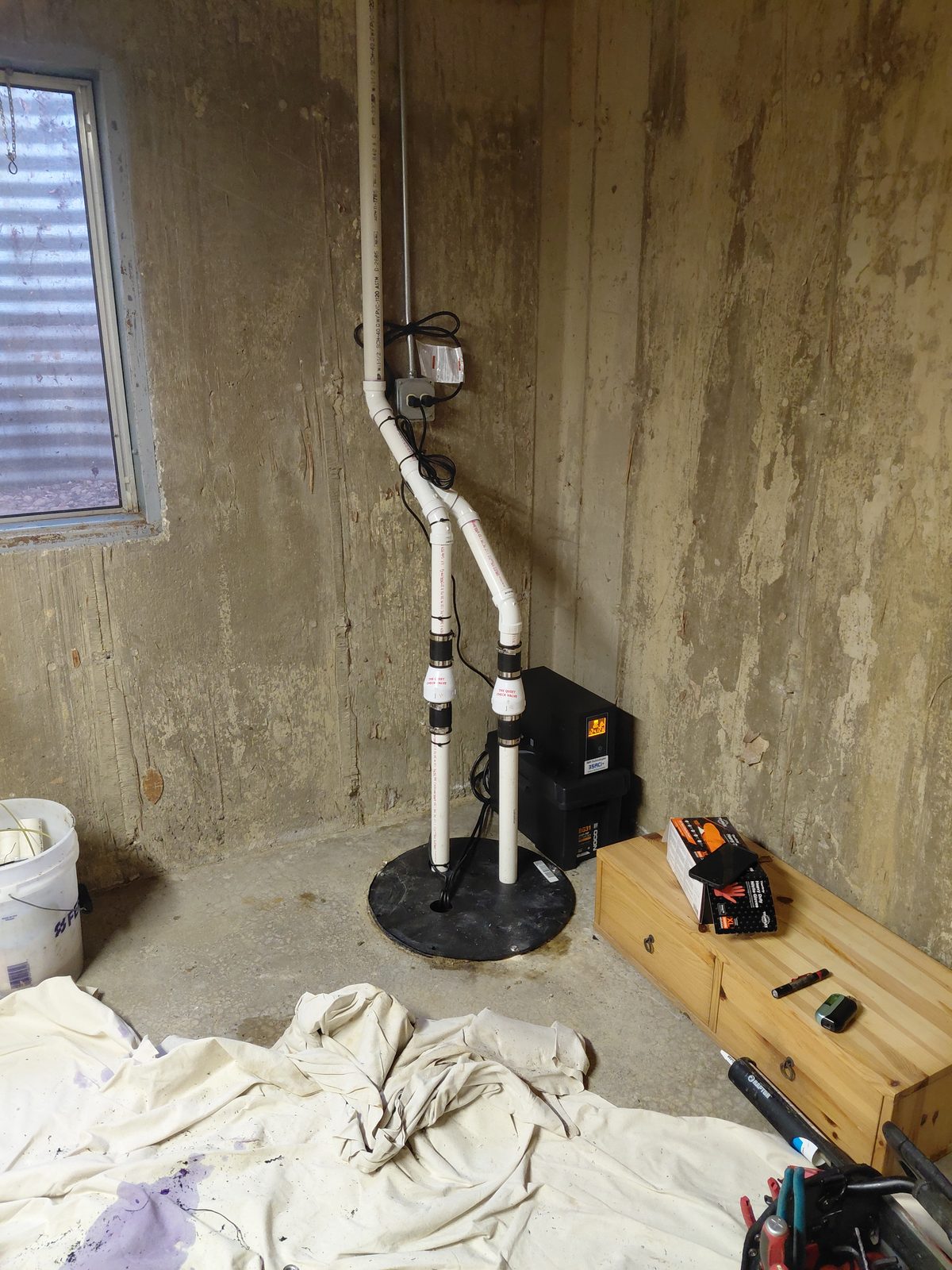
For the primary pump, we install Liberty Pumps almost exclusively. Commercial-grade, built to run, and backed by a manufacturer we can actually reach when a warranty issue comes up. We stopped installing box-store brands years ago after too many warranty callbacks.
- Liberty 257 — 1/3 HP, vertical float, perfect for standard residential pits.
- Liberty 287 — 1/2 HP for larger pits or homes with high water tables.
Battery backup — Pro Series
We install Pro Series battery backup systems almost exclusively. What sets them apart:
- Pro Series C22 & C33 — DC pumps that push real GPM even when the primary is out. C33 is our go-to for higher-demand pits.
- Wi-Fi monitoring options — alerts you when the pump runs, when battery is low, when water is high.
- Deep-cycle marine batteries — extended continuous pumping capacity through long outages.
- Trickle charge maintenance — battery stays topped off, ready for the next storm.
Water-Powered Backup Pumps: An Underrated Option
For homes on municipal water with adequate pressure (most of our service area), we can also install a water-powered backup. It uses your city water pressure to pump the pit dry when your electric pump fails. No battery to maintain, no charge cycle to worry about, unlimited runtime. Downside: it uses roughly 1 gallon of city water to pump 2 gallons out of the pit, so it's a backup, not a primary.
Discharge Line: The Forgotten Failure Point
Half the sump failures we diagnose aren't the pump — they're the discharge. Things we check and fix:
- Freeze-resistant terminations. Standard PVC dumped into a Chicagoland yard freezes. We install grate-style terminations that shed ice and let water escape sideways if the main line freezes.
- Proper pitch. Discharge lines must pitch away from the foundation and drain fully between cycles. Belly = frozen line.
- Check valve. A silent check valve on the discharge prevents backflow into the pit — critical, and often installed backward by inexperienced plumbers.
- Adequate distance. Discharge should exit at least 10 feet from the foundation. We've seen new builds where the discharge dumps directly onto the window well.
Sump Pump Annual Maintenance Checklist
You can do half of this yourself. The rest we do during an annual service visit.
You can do
- Pour a 5-gallon bucket into the pit — pump should turn on within a few seconds and drain the pit quickly.
- Listen for the motor — rattling, grinding, or humming without pumping = replace time.
- Check the battery voltage display (if you have Pro Series) — should be 12.5V+ resting.
- Visually inspect the discharge line for cracks, sagging, or ice damage.
We do (annual service)
- Pull and clean the pump body — silt buildup kills pumps.
- Test check valve for proper seal.
- Load-test the backup battery (most fail during load test 3–4 years in).
- Verify float switch operates freely across full range.
- Camera-scope the discharge line to the yard termination if history warrants it.
Warning Signs You Need a New Sump Pump — Right Now
- Pump runs constantly (even when it's not raining) — pit is filling from a source you don't know about, or the check valve is bad.
- Pump vibrates loudly — impeller is damaged or debris is bound in the housing.
- Cycles rapidly — pit is too small for the pump size, or the pump is on its last legs.
- Rust-colored water in the pit — pump housing is corroding internally.
- Battery backup beeping — battery is at end-of-life, replace immediately.
- More than 8 years old — you're on borrowed time. Plan the replacement now, not after the flood.
Don't wait for the storm. Get your sump system inspected and upgraded before spring rains hit.
Sump Pump FAQ
How much does sump pump installation cost in Chicagoland?
Cost depends on pit size, primary pump HP, whether a battery backup is included, and the state of your existing discharge line. We come out, evaluate the pit and drainage, and provide a firm written quote before any work begins.
Should I get a maintenance contract?
For sump pumps specifically, yes. An annual checkup catches the two things you can't see: check valve fatigue and battery degradation. Both are cheap to fix on schedule; both cost a fortune to fix after a failure.
Can you install a sump pump where there isn't one?
Yes. We break the basement slab, install a sump basin below floor level, tie it into the perimeter drain tile (or install new drain tile), and pump discharge to the exterior. It's a 1–2 day job depending on tile work needed.
Do you service sump pumps 24/7?
Yes. If your basement is flooding right now, call (847) 306-9736. We keep spare Liberty and Pro Series pumps on the trucks and can swap most systems the same night.
Ready to talk water heaters?
Get a firm quote from a Level 3 Certified installer.
We'll come out, size the right unit for your family, and give you an all-in price before any wrench turns. No pressure, no surprise adders.