
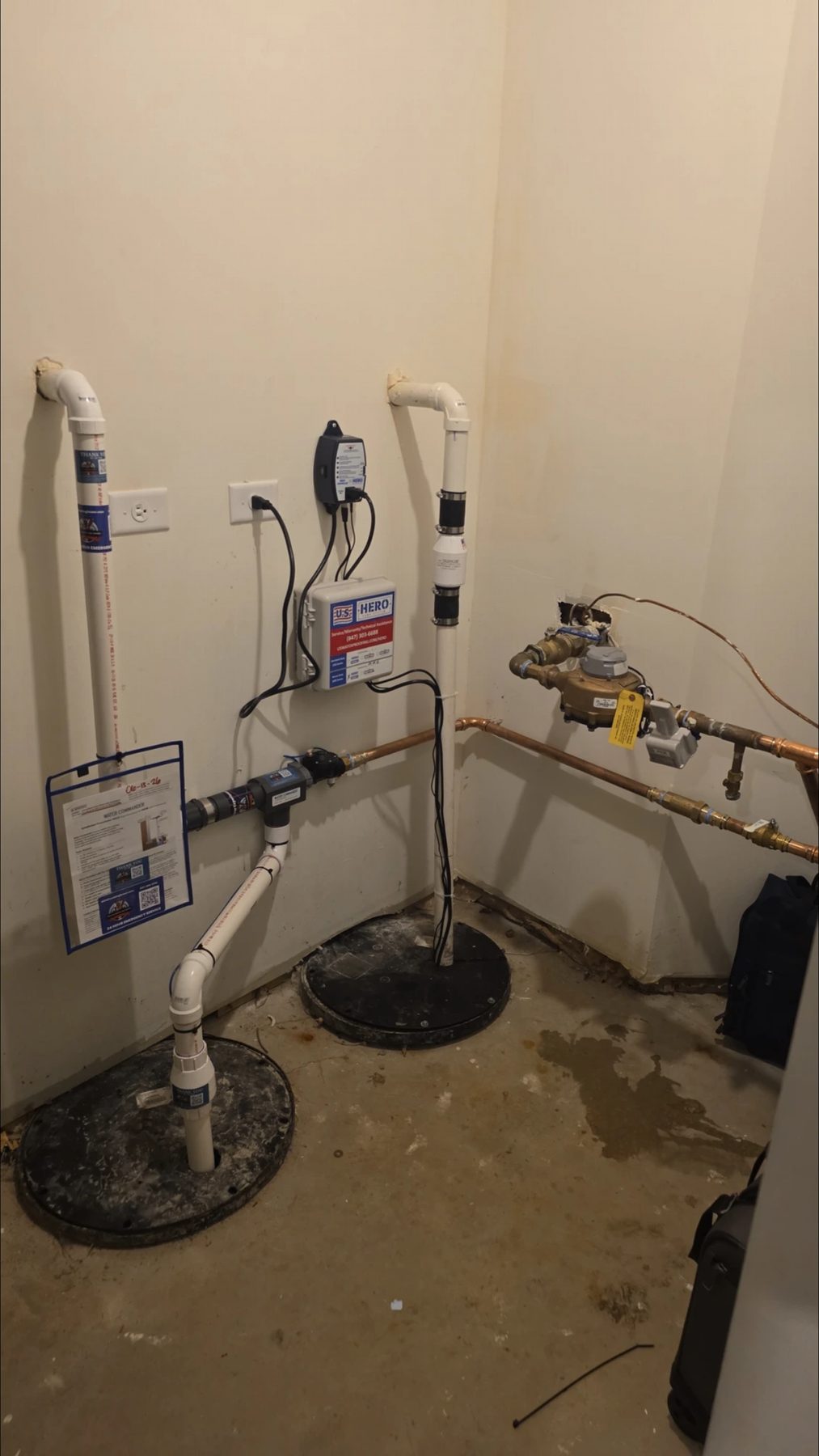
The install in the photo above is a Water Commander MG-series backup we set for a Chicagoland homeowner. It sits alongside the primary Liberty sump pump, tied into the municipal water supply on the right wall, ready to run indefinitely the next time ComEd goes out during a summer thunderstorm. No battery to check. No annual load test. No countdown to replacement. It's a fundamentally different way to solve the backup sump problem, and for the right home, it's the last backup pump you'll ever install.
Here's how the Water Commander MG22 and MG33 actually work, when they're the right call, and — importantly — when they aren't.
The Problem With Battery Backup Sumps
We install a lot of battery backup systems (our default is the Pro Series C22 and C33) and they work great. But they share a set of limitations that homeowners tend to forget about between storms:
- Batteries have a shelf life. Deep-cycle marine batteries need to be replaced every few years. Miss a replacement window and you've got a battery backup with no battery capacity when the storm hits.
- Runtime is finite. Even a fully charged battery has a fixed number of gallons it can pump before it's depleted. A long outage during a heavy rain event can outlast the battery.
- Trickle chargers can fail silently. If the charger stops maintaining the battery and no one notices, you're running blind.
- Annual load-testing is a real maintenance task — one that most homeowners aren't performing.
Battery backups are excellent when the maintenance is kept up. But maintenance memory is exactly the point of failure that turns a battery backup into a wet basement.
How the Water Commander Works
The Water Commander is a water-powered ejector pump — no electricity, no battery, no moving parts on the motor side because there is no motor. It works on a physics principle called venturi action: when high-pressure water is forced through a specifically-shaped orifice, it creates a strong low-pressure zone that pulls a second fluid (in this case, the water in your sump pit) along with it and pushes both out through the discharge.
Simplified sequence when the power is out and your sump pit fills:
- The water level in your pit rises past the primary pump (dead without power) up to the Water Commander's float.
- The float opens a valve on the municipal water supply feed.
- City water pressure jets through the venturi, which suctions water out of the pit and out to the discharge line.
- When the pit empties, the float drops and the valve closes.
- Everything about that cycle is mechanical. No sensors to fail, no board to burn out, no charge cycle. It runs as long as your city water pressure is running.
MG22 vs. MG33: Which One Fits Your Home
Both the MG22 and MG33 use the same water-powered principle. The difference is capacity — how many gallons per minute the pump can move out of your pit for a given feed-line pressure.
Water Commander MG22
The standard residential model. Handles typical Chicagoland pit demand for average-sized homes, standard basements, and normal groundwater conditions. If your primary pump is a 1/3 HP Liberty 257 and you've never had it cycling faster than every couple of minutes during a heavy rain, an MG22 is generally correct.
Water Commander MG33
Higher-capacity model. Right for larger pits, higher-demand basements, homes with high water tables, or households whose primary pump is 1/2 HP and running frequently. If we scope your existing sump activity and see aggressive cycling under storm conditions, we spec the MG33.
We size the model to your specific installation during our evaluation — feed-line pressure at the sump location, primary pump capacity, pit size, and your storm-cycling history all factor in.
Who the Water Commander Is For — And Who It Isn't
The Water Commander fits your home if:
- You're on municipal water — city or village water service, not a well.
- You have adequate incoming water pressure — typically 40 PSI or higher (we measure at the install location to confirm).
- You want a set-it-and-forget-it backup with no batteries, no maintenance calendar, and no runtime limit.
- You're staying in the home long-term — the 25+ year lifespan pays back over decades, not years.
- You've had a battery-backup runtime issue — you flooded during a long outage because the battery died before the power came back on.
The Water Commander does NOT fit your home if:
- You're on well water. This one is non-negotiable. When your power goes out, your well pump stops, and the pressure in your plumbing bleeds out within minutes. The Water Commander has nothing to draw against and cannot function. In well-water homes we install a battery backup system instead — that's the correct tool for that infrastructure.
- Your municipal water pressure is low. Some older parts of certain Chicagoland service areas run marginal static pressure. We measure before we quote — if we're not seeing at least 40 PSI at the install location, we recommend a different solution.
- You're on a private septic system with strict water-usage restrictions. The Water Commander does use municipal water when it runs. In a normal storm event this is a modest amount, but in edge cases it's worth thinking about.
25+ Year Expected Service Life — What That Actually Means
Battery backup systems have to be treated as consumable — you're replacing the battery every few years, and the pump itself every decade or so. The Water Commander is built differently. Why the long service life:
- No electric motor to burn out, no impeller bearings to wear.
- Brass and stainless-steel construction on the wetted surfaces — corrosion-resistant materials sized to last.
- No high-cycle electronic components — it's a mechanical valve and a venturi.
- Minimal duty cycle — because it only runs when your primary pump can't (power outage or primary failure), the total run-hours over decades stays low.
We have Chicagoland customers with Water Commander installs approaching 20 years that still test flawlessly. The manufacturer's own service history supports 25+ years of reliable operation under normal conditions, and in practice we don't see them come out of homes until the homes themselves are being repiped.
How We Install the Water Commander
The install matters. Done right, it's invisible until the power goes out — and then it saves your basement. Details of an MDM install:
- Pressure verification at the install location. We measure the incoming municipal supply pressure at the sump area before we finalize the pump size.
- Dedicated tap off the municipal supply upstream of the water softener (so soft-water cycles never interfere with backup availability).
- Backflow prevention. Required by Illinois plumbing code — the discharge cannot cross-contaminate the municipal supply. We install the appropriate air gap and backflow device as part of every setup.
- Discharge tied into the primary sump's discharge line with proper check valves on both pumps so neither can short-cycle the other.
- High-water alarm wired into the same controller that oversees the primary pump (the small unit visible in the photo).
- Full test cycle. We manually raise the float and confirm the pump activates, verify flow rate, and shut it down cleanly. You watch the whole test.
- Municipal permit where the village requires it (Elk Grove Village, Schaumburg, Lombard, Naperville, Bloomingdale — most local jurisdictions require a plumbing permit for a backup sump install).
How It Compares to Battery Backup (Head-to-Head)
- Runtime. Battery: finite, dictated by battery capacity. Water Commander: unlimited as long as municipal water is on.
- Maintenance. Battery: every 2–4 years replace battery, annual load test recommended. Water Commander: functional testing every year or two, no consumables.
- Lifespan. Battery pump: 8–12 years typical. Water Commander: 25+ years typical.
- Well-water compatibility. Battery: works fine. Water Commander: not compatible.
- Silent-charging failure risk. Battery: exists (dead charger, dead battery, no warning). Water Commander: no.
- Uses water when running. Battery: no. Water Commander: yes (small quantity relative to a flooded basement).
Neither system is universally "better" — they're tools for different infrastructure. On municipal water with adequate pressure, we lean toward the Water Commander when the homeowner values low maintenance and long service life. On well water or where pressure is marginal, battery backup is the answer.
On municipal water and want a backup sump you don't have to think about? Book a Water Commander evaluation — we'll measure your pressure and confirm the right model.
Water Commander FAQ
How much water does the Water Commander actually use when it runs?
It uses roughly one gallon of municipal water to pump two gallons out of the sump pit. In a normal storm outage that means a modest amount of city-water usage in exchange for keeping your basement dry — a trade every homeowner we've installed one for has been happy to make.
Does it work if the municipal water goes out too?
No — it needs incoming water pressure to function. In practice, municipal water rarely fails during residential power outages because water utilities run on grid-independent infrastructure, but it's worth understanding the failure mode.
Can I install this myself?
Legally in Illinois, no — it requires a licensed plumber and typically a permit. Practically, the backflow prevention, pressure verification, and code-compliant tap into the municipal supply need to be done right. This isn't a DIY installation.
Can I have both a Water Commander and a battery backup?
Yes — some Chicagoland homeowners want belt-and-suspenders coverage and run all three (primary electric + battery backup + Water Commander). It's over-engineered for most homes but sensible for finished basements, homes with high water tables, or households where the finished basement contains irreplaceable belongings.
How do I know if my incoming water pressure is high enough?
We measure it at the intended install location before we quote. If it's under 40 PSI we don't try to force the installation — we tell you honestly that a battery backup is a better fit for your home.
Do you offer 24/7 emergency sump service?
Yes. If your basement is flooding right now, call (847) 306-9736. We can often restore primary operation the same visit and quote a Water Commander install as the permanent upgrade.
Ready to talk water heaters?
Get a firm quote from a Level 3 Certified installer.
We'll come out, size the right unit for your family, and give you an all-in price before any wrench turns. No pressure, no surprise adders.