
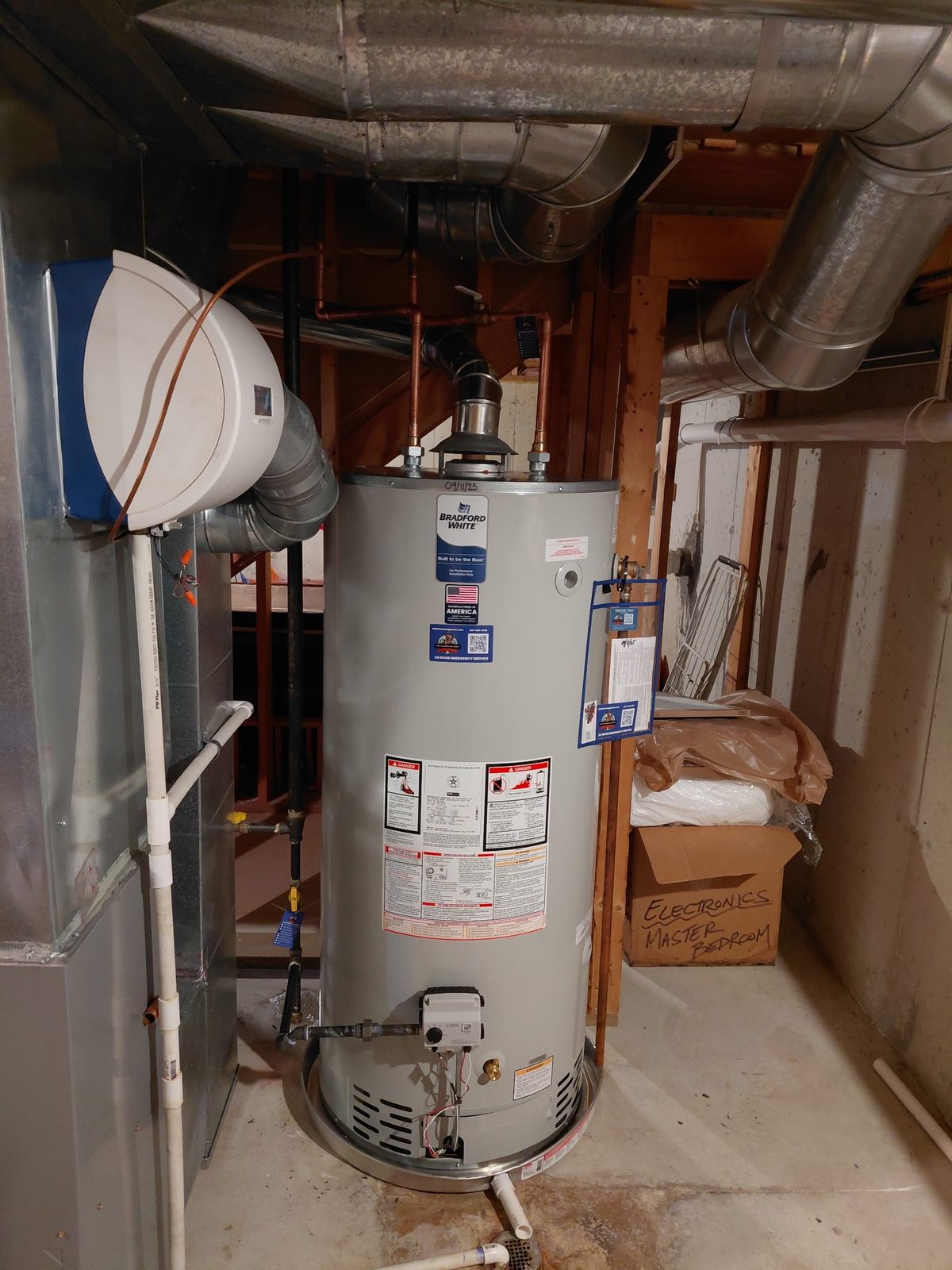
"My hot water takes forever" is one of the most common calls we get. But when we dig in, it usually turns out to be one of two very different problems — and the fix depends entirely on which one you have.
- Delivery delay — the water heater is fine, but it takes a long time for hot water to travel from the heater to your faucet.
- Slow recovery — the water heater itself is struggling to heat water, so you run out fast or it takes too long to get hot again.
As Bradford White and Level 3 Certified Navien installers serving Elk Grove Village, Schaumburg, Arlington Heights, Lombard, Naperville, and the surrounding suburbs, here are the causes we find most often — starting with the ones you can check yourself.
Delivery Delay: When Hot Water Takes Too Long to Reach the Faucet
1. Distance from the water heater
Every foot of pipe between the heater and the fixture is full of water that's cooled off since the last use. You have to run that cold water out before the hot arrives. In a lot of Chicagoland homes, the water heater is in the basement on one end of the house and the primary bathroom is on the second floor at the other end — that can easily mean a long wait.
2. Larger or uninsulated pipes
Bigger pipes hold more water, so there's more to purge before hot arrives. Uninsulated hot lines running through a cold basement or crawlspace also lose heat fast, especially in a Chicagoland winter.
3. Low-flow fixtures
Water-saving faucets and showerheads are great for your bill, but they move less water per minute — so it takes longer to push the cooled water out of the line.
The fix: hot water recirculation
A recirculation system keeps hot water moving through the line so it's near the fixture when you need it. Options include a dedicated return-line recirculation pump, a retrofit system that uses the cold line as a return, or a tankless water heater with built-in recirculation. Several Navien models offer built-in recirculation with scheduling, so you get near-instant hot water without running a pump around the clock. Insulating accessible hot water lines also helps.
Slow Recovery: When the Water Heater Itself Is Struggling
4. Sediment buildup in the tank
This is the most common cause we see in Chicagoland. Our hard water drops minerals that settle on the bottom of a tank heater. On a gas heater, that layer sits between the burner and the water and acts like insulation — the burner runs longer to heat the same water. You'll often hear rumbling or popping. Regular flushing helps prevent it; once a tank is heavily scaled, flushing may not fully recover its performance.
5. A broken or deteriorated dip tube
The dip tube carries incoming cold water to the bottom of the tank. If it cracks or breaks off, cold water dumps in at the top — right next to the hot water outlet — and mixes with your hot water. The result: lukewarm water that runs out quickly even though the heater seems to be working. Plastic dip tube fragments can also show up in faucet aerators.
6. Undersized water heater
A 40-gallon tank that was fine for a couple can't keep up with a family of five, back-to-back showers, and a dishwasher. If your household has grown, or the previous owner installed the cheapest heater available, the tank simply may not have the capacity or recovery rate for your demand.
7. Gas burner or control problems
- A dirty burner or partially blocked air intake produces a weak, yellow flame that heats slowly.
- A failing thermocouple or flame sensor can cause the burner to drop out and relight repeatedly.
- A faulty gas control valve or thermostat may not be bringing the tank up to the set temperature.
- Venting issues — a blocked or improperly drafting vent can cause the heater to shut down or run poorly. This is also a safety issue and should be checked by a pro.
8. Failed heating element (electric heaters)
Electric tank heaters usually have an upper and lower element. When the lower element fails, the heater still makes some hot water from the upper element — but much less of it, and it recovers slowly. Hard-water scale on elements also cuts their efficiency over time.
9. Thermostat set too low
Sometimes the fix is simple. If the thermostat was turned down by a previous owner or bumped during a move, the water will never get as hot as you expect. Around 120°F is a good starting point for most homes.
10. Cold incoming water in winter
In Chicagoland, incoming water gets significantly colder in the winter months. Your heater has to raise that water through a bigger temperature rise, so recovery is slower in January than in July. A heater that's already borderline in size will show it first in the winter.
11. Old age
Tank water heaters in our area typically last 10–12 years. As they age, scale, sediment, and worn components all combine to reduce performance. If your heater is in that range and slowing down, replacement is often the smarter move than repair.
Tankless Water Heater Running Slow or Lukewarm?
Tankless units have their own set of causes:
- Scale on the heat exchanger. Hard water builds scale inside a tankless unit just like a tank. Annual descaling is essential in Chicagoland.
- Undersized unit for winter temperatures. A tankless sized for a warm climate can't deliver enough hot water flow when Chicagoland groundwater is at its coldest.
- Undersized gas line. High-output tankless units need a gas supply sized for their full demand. A line that's too small starves the burner.
- Flow below the activation threshold. Very low flow — like a barely-open faucet — may not trigger the unit to fire.
- Dirty inlet filter. A clogged inlet screen restricts flow and performance.
One Fixture Only? Check the Fixture
If the kitchen sink is hot but one shower is lukewarm, the water heater probably isn't the problem. Shower pressure-balancing and thermostatic valves have cartridges and limit stops that wear out or are set too low. A faulty single-handle faucet cartridge can also let cold water cross over into the hot side.
How We Diagnose Slow Hot Water
- Identify delivery vs recovery by checking temperatures at the heater and at the affected fixtures.
- Inspect the heater — age, sediment, burner or element condition, dip tube, thermostat, venting, and gas supply.
- Evaluate sizing against your household's actual demand.
- Recommend the right fix — a repair, a flush, a recirculation solution, or a replacement with a Bradford White tank or Navien tankless — and quote it firm before any work starts.
Tired of waiting for hot water or running out halfway through a shower? Book a service call — we'll find out why and quote the fix firm before we start.
Slow Hot Water FAQ
How long should it take for hot water to reach my faucet?
It depends on the distance and pipe size, but if you're waiting much more than a minute at a regularly used fixture, a recirculation system is worth considering.
Can flushing my water heater fix slow heating?
If sediment is the cause and the tank isn't too far gone, yes. On older tanks with heavy buildup, flushing may help only a little — and on very old tanks, disturbing the sediment can sometimes expose leaks.
Will a tankless water heater give me instant hot water?
Not by itself. Tankless gives you endless hot water, but it still has to travel through the pipes to your faucet. Pairing tankless with recirculation — like Navien's built-in recirculation models — is what gets you close to instant.
Do you offer same-day water heater service?
In most of our core service area, yes. Call (847) 306-9736 — we prioritize no-hot-water and leaking water heater calls across Elk Grove Village, Schaumburg, Arlington Heights, Lombard, Bloomingdale, and neighboring suburbs.
Ready to talk water heaters?
Get a firm quote from a Level 3 Certified installer.
We'll come out, size the right unit for your family, and give you an all-in price before any wrench turns. No pressure, no surprise adders.